Perceived traffic safety's impact on cycling route choice with street-level images
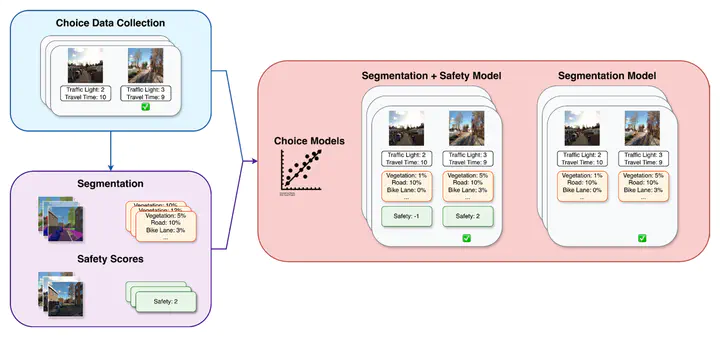 Overview of the methodological approach combining street-level imagery, computer vision, and discrete choice modeling.
Abstract
Perceived traffic safety influences cycling behavior, yet its value relative to travel time and other route attributes remains unquantified. Building on the stated choice experiment and street-level image dataset of Terra et al. (2025), we extract safety perception scores from cycling-perspective images using a computer vision model and estimate mixed logit models to test whether perceived safety affects route choice after controlling for visual street-level features. Cyclists are willing to accept 64 additional seconds of travel time for a one-unit increase in perceived safety (scale: -2 very unsafe to +2 very safe). Safety preferences vary across demographic groups: older cyclists, recreational cyclists, and those with positive cycling attitudes place more weight on safety, while commuters prioritize speed. These willingness-to-pay estimates enable planners to quantify perceived safety improvements for cost-benefit analyses and to score existing cycling networks for targeted infrastructure upgrades.

Koichi Ito
Urban Development Specialist (Young Professional)
Urban Development Specialist (Young Professional) at the Asian Development Bank. My research focuses on urban analytics, human mobility, and street view imagery.